Costa Rica for a Month: Jacó vs Tamarindo vs Santa Teresa
What matters for four days is not what matters for thirty.
For a short vacation, you optimize for the beach, the atmosphere, a few tours and maybe the nightlife. Almost any of Costa Rica's beach towns can deliver a great week.
A month is a different problem. You're not visiting a place — you're temporarily living in it. That shifts the priorities: monthly rental availability, everyday cost, groceries, internet, whether you need a car, how far the airport is, healthcare and pharmacies, laundry, a gym, noise, a workable routine, weekend trips, social life — and yes, still the beach.
We own a condo in Jacó and have spent real time in all three towns, so we're not neutral — but we'll be upfront about what each town does well and where Jacó is not the best pick. Transport times below are sourced; impressions of cost and atmosphere are our own experience.
The three towns at a glance
| Jacó | Tamarindo | Santa Teresa | |
|---|---|---|---|
| Monthly rental practicality | Finding a furnished monthly condo was straightforward, in our experience | We found plenty of options, generally at higher prices | Our impression: a smaller pool of monthly rentals, and popular places book out |
| Relative cost | Lowest of the three, in our experience | Materially more expensive than Jacó, in our experience | Higher than Jacó, in our experience |
| SJO access | About 1.5–2 h by car (≈100 km) (source) | 4–5 h drive (≈250 km); most fly into Liberia instead (source) | About 5 h including a ferry crossing (source) |
| Car dependency | Central Jacó works without a car, in our experience | Easier with a car for anything beyond the center | Most visitors we met rented an ATV or car |
| Walkability | Flat, compact town center | Walkable core, spread-out edges | One long main road connecting everything |
| Remote-work practicality | Solid internet options and coworking, in our experience | Good infrastructure, many work-friendly cafés | Workable, but less consistent infrastructure — our impression |
| Groceries / daily services | Full-size supermarkets, pharmacies, banks in town | Good coverage for a tourist town | Smaller shops, higher prices, in our experience |
| Restaurants | Wide range, from local sodas to upscale | Large international restaurant scene | Standout food scene, in our experience |
| Nightlife | Active, from chill bars to late-night | Active and tourist-oriented | Lower-key, beach-bar style |
| Beach | Long dark-sand town beach, popular for surf | Town-center bay beach, surf-school friendly | Surf-focused beaches along the coast |
| Social / nomad scene | Present but low-key | Most visible nomad presence of the three | Surf- and wellness-centered scene |
| Weekend-trip access | Carara, Manuel Antonio, Uvita all within easy reach | Guanacaste beaches and parks nearby | Constrained by the ferry and road times |
| Best for | Convenience and access | International tourism and nomad ecosystem | Food and surf atmosphere |
Note: only the SJO access and weekend-trip access rows are based on the linked sources (drive times and distances). Everything else — monthly rental practicality, relative cost, car dependency, walkability, remote work, groceries, restaurants, nightlife and the social scene — reflects our firsthand experience from our stays, not measurements. Treat those rows as informed opinion.
Jacó
Best when convenience and access matter
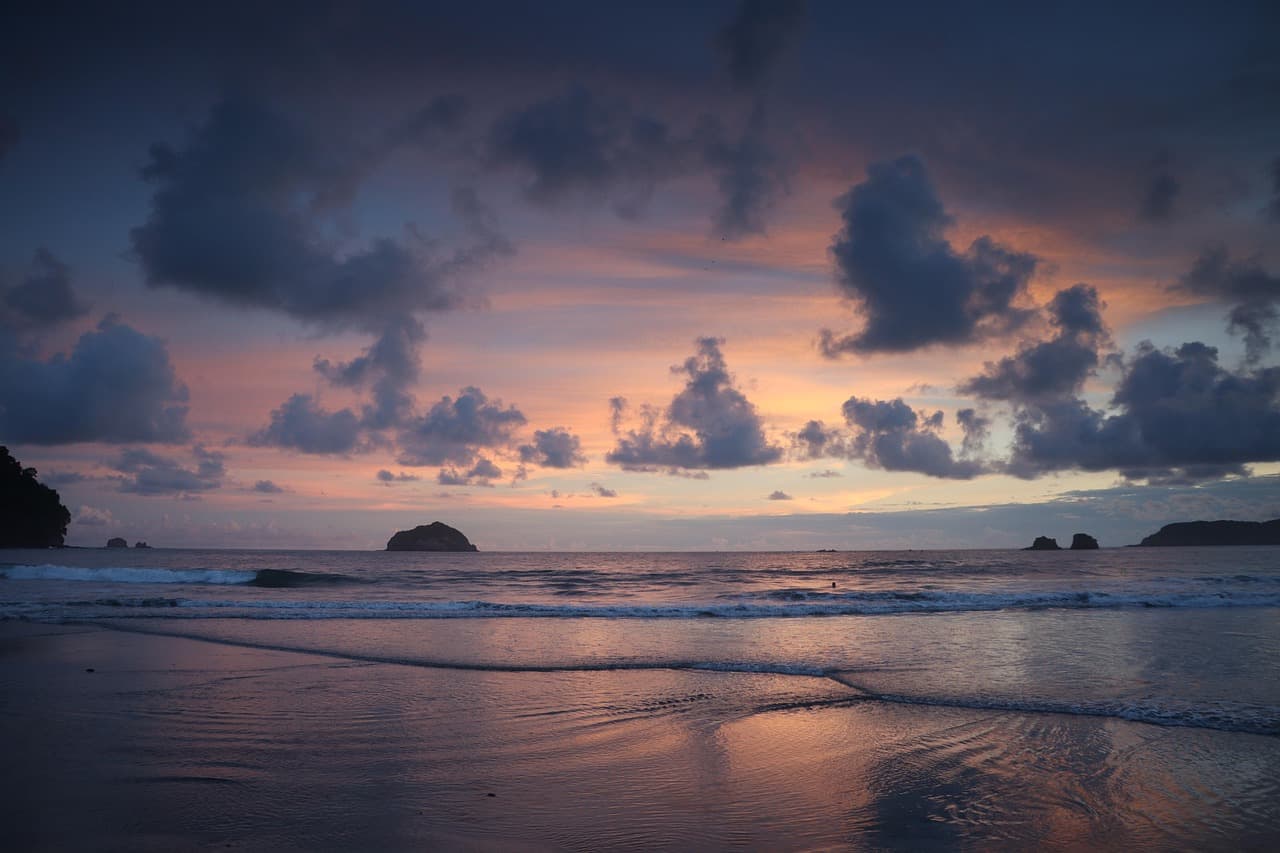
Jacó's biggest structural advantage is simple: it is the closest major beach town to the international airport. It's about 1.5–2 hours by car from San José's SJO airport (≈100 km on the Route 27 toll highway) (second source). You can also skip driving entirely: direct public buses run between San José (Terminal Atlántico Norte) and Jacó roughly every two hours with Transportes Jacó — about 2–2.5 hours each way for around ₡2,900 (roughly US$5–6; fares adjust periodically).
In our experience, a month in Jacó can be as slow or as active as you want. There is nightlife if you want it, but also quiet cafés and bars, a real surf culture, and plenty of sports. Central Jacó is flat and compact enough that we've lived there comfortably without a car: supermarkets, pharmacies, banks, gyms and laundry are all in walking distance. And of the three towns, Jacó has consistently been the cheapest for us — we broke down what a month in Jacó actually costs — our real bills.
Two honest caveats. Jacó is hot and humid year-round — you will want air conditioning. And some nightlife areas get hard-edged late at night, with visible drug dealing and sex work; it's concentrated in a few blocks and easy to avoid, but you should know it exists before choosing the town.
Where Jacó quietly wins for a month-long stay is weekend trips. Carara National Park is about 20–25 minutes north (≈15 km, past the Tárcoles crocodile bridge, and home to Costa Rica's largest population of wild scarlet macaws). Manuel Antonio is about 1.5 hours south (≈70 km), Uvita and Marino Ballena National Park about 2–2.5 hours south (≈125 km), and Nauyaca Waterfalls about 2–2.5 hours away (Route 34 to Dominical, then 10 km inland). Over four weekends, that access adds up.
Tamarindo
Best when you value a larger international tourism and nomad ecosystem
Tamarindo is the most internationally developed of the three, in our experience. It draws more tourists, has a more obvious digital-nomad presence, and offers the most polished tourism infrastructure — tour operators, surf schools, international restaurants and services aimed squarely at foreign visitors. If you want to land in a place where a large English-speaking community is already set up, we found Tamarindo the easiest of the three.
That ecosystem comes at a price. In our experience, a month in Tamarindo is materially more expensive than a month in Jacó — rentals, restaurants and day-to-day spending all run higher.
Getting there is the other trade-off. Tamarindo is a 4–5 hour drive from SJO (≈250 km); most visitors fly into Liberia (LIR) instead, about an hour and a quarter away. If your international flights route through Liberia anyway, that's a non-issue. If they route through San José, it adds a real travel day on each end.
Santa Teresa
Best when food, surf lifestyle and destination atmosphere matter more than convenience
Santa Teresa has earned its reputation for two things: surf and food. The restaurant scene is genuinely strong for a town its size — in our experience, the best of the three — and the whole place is built around a surf-first lifestyle. If that's the month you want, Santa Teresa delivers an atmosphere the other two don't.
Our honest opinion: we personally find it overhyped relative to its cost. A month there has been noticeably more expensive than Jacó for us, and day-to-day logistics — one long main road, smaller shops, most visitors we met renting an ATV or car to get around — take more effort than the destination-town image suggests. That's a judgment call, not a fact; plenty of people happily spend months there.
The hard fact is access. From SJO it's about 5 hours: drive roughly 2 hours to Puntarenas, take the ~75-minute car ferry to Paquera, then drive about an hour more — or roughly 5.5–6 hours driving around the gulf. For a one-off month that's manageable; if you expect visitors, side trips or a mid-stay flight, it compounds.
So which town should you pick?
Choose Jacó if…
…you want convenience: the shortest trip from SJO, a daily life that works without a car, lower costs in our experience, and full-town infrastructure — supermarkets, pharmacies, gyms, banks — within walking distance.
Choose Tamarindo if…
…you want the largest international tourism scene and the strongest nomad presence of the three, with the most polished tourism infrastructure we saw — and the higher cost is acceptable.
Choose Santa Teresa if…
…food, a surf-oriented lifestyle and destination atmosphere matter more to you than logistics, and you're fine with the ferry-or-long-drive access and a car or ATV for daily life.
For four days, beach quality can dominate. For a month, convenience compounds.
If Jacó sounds like the right fit
We rent our furnished 2-bedroom condo at Viva Jaco by the month — a 5-minute walk to Jacó Beach, $1,500/month in June–November and $2,500/month in December–May.
Not sure about the budget? Read what a month in Jacó actually costs — our real bills.